
How MCM Flexible Stone Veneer Is Changing Architectural Surfaces
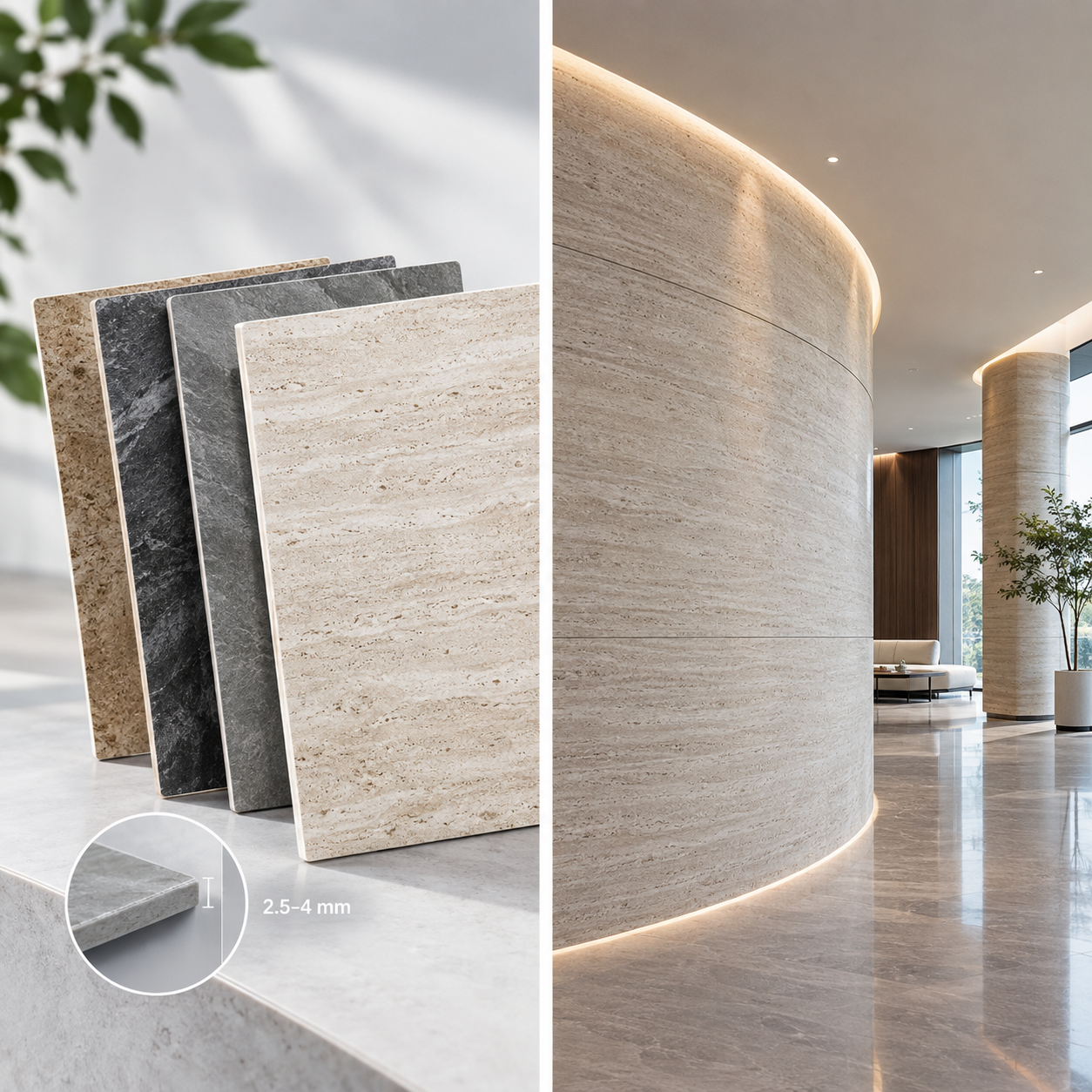
Architectural finishes are being asked to do more with less build-up, less structural demand and shorter installation windows. Renovation, curved interiors and branded retail environments have made material flexibility a genuine project requirement rather than a novelty.
MCM Flexible Stone Veneer responds to that shift with thin mineral-textured surfaces for facades and interiors. Based on RINSUN's work with project buyers, distributors and contractors, WUXI RINSUN ECO MATERIALS CO., LTD examines where the category adds value, what risks remain, and how better specifications prevent disappointing installations.
Table of Contents
1. Why Lightweight Architectural Surfaces Are Gaining Attention
2. Renovation Projects Reward Thin and Adaptable Materials
3. Wall Finish Systems Compared for Common Projects
4. Curved Surfaces Are Becoming a Specification Driver
5. Exterior Use Requires System Level Decisions
6. Distribution Is Moving Toward Sample Led Selling
7. A Retail Refit Case Shows the Value of Channel Planning
8. Frequently Asked Questions
9. Build a Better Flexible Stone Specification
Why Lightweight Architectural Surfaces Are Gaining Attention
Renovation, adaptive reuse and fast commercial fit-outs are changing how architects evaluate wall finishes. The question is no longer limited to whether a surface resembles stone. Teams also examine installed weight, thickness, substrate demands, cutting, access, labor sequence and the ability to continue a finish across non-flat geometry. Those practical pressures have created a clear role for thin flexible veneers.
MCM Flexible Stone Veneer sits between decorative sheet materials and traditional rigid cladding. It is intended to reproduce mineral texture in a flexible format, not to replace structural stone. That distinction matters because its value is tied to the wall system and use case. Curved columns, radiused retail fixtures, existing walls and ceiling features can benefit in ways that a simple square-meter price comparison will miss.
For buyers, the growth of this category makes supplier evaluation more important. Surface realism, batch consistency, technical documentation and installation support vary widely. A strong specification must define the visual target and the physical conditions of use.
Renovation Projects Reward Thin and Adaptable Materials
Existing buildings rarely offer perfect surfaces or generous transition depth. Thick finishes can conflict with doors, skirting, glazing and service penetrations. Heavy cladding may also require additional support. A thin veneer can reduce some of those interventions, provided the existing substrate is stable, dry and properly prepared.
Speed is another factor. Commercial spaces often close for short refurbishment windows. Large thin panels can cover area efficiently, while flexible construction reduces cutting around gentle curves. Yet installation speed should not be confused with skipping preparation. Moisture, loose paint or uneven backgrounds remain common causes of failure.
The best renovation decisions follow a survey and mock-up. The project team verifies adhesion, flatness, color, joint layout and edge treatment on the actual wall. This modest step produces better evidence than relying on a showroom board alone.
Wall Finish Systems Compared for Common Projects
Finish system | Geometry | Weight and build-up | Installation planning |
MCM flexible veneer | Flat walls and gentle curves | Thin, reduced-weight facing | Clean stable substrate, compatible adhesive and planned joints |
Natural stone slab | Primarily flat or specially fabricated curves | Heavy and structurally demanding | Anchors or engineered fixing, lifting and skilled stone work |
Rigid porcelain tile | Flat surfaces; segmented curves | Moderate, with repeated joints | Mortar or adhesive, grout grid and cut planning |
Decorative laminate | Flat and selected formed interiors | Thin and lightweight | Interior substrate, edge treatment and service limits |
Curved Surfaces Are Becoming a Specification Driver
Hospitality, retail and exhibition designers increasingly use rounded corners, arches, columns and continuous sculptural forms. Rigid tiles can follow these shapes only through smaller modules, special fabrication or visible segmentation. Flexible veneer can maintain a broader visual field around gentle curves, which changes both appearance and installation planning.
The material still has a directional limit. Slate grain, linear texture and travertine veining behave differently when bent or rotated. Designers should show the intended direction on drawings and test the most demanding radius. A curve that works across the width may behave differently along the length.
RINSUN's completed-project references include exhibition arches, curved retail fixtures, commercial counters, wall details and stair enclosures. These real installations show the category's design range without implying that one product or detail fits every substrate. Project-specific review remains essential.
Exterior Use Requires System Level Decisions
An exterior veneer faces rain, temperature change, ultraviolet exposure, wind effects and movement between materials. Product selection is only one part of performance. Substrate condition, adhesive coverage, joint design, perimeter sealing, flashings and local code requirements must be coordinated by the project team.
Documentation should identify the selected series and the conditions covered by available test data. RINSUN provides TDS, MSDS and installation guidance on request. Certification marks and test results should be used only when the corresponding verified file applies to the actual product and market. This is better practice than copying a generic mark onto every brochure.
Mock-ups are particularly useful on facades. They allow teams to review color in daylight, water-sensitive details, seam rhythm and workmanship. They also create a common acceptance reference for architect, contractor and supplier.
Distribution Is Moving Toward Sample Led Selling
Flexible stone is tactile. Texture depth, color movement and bending behavior are difficult to judge on a screen. Distributors therefore benefit from physical sample sets supported by accurate labels, application photography and technical documents. The sample should represent current production rather than an idealized display piece that cannot be repeated.
A useful sample program separates surface selection from project approval. Small pieces help a customer choose Travertine, Line or Natural directions. Larger panels or job-site mock-ups then confirm pattern repetition, seams and substrate interaction. This two-stage approach prevents a color chip from carrying decisions it cannot support.
RINSUN offers free samples before order and supports both LCL and FCL export. For distributors, the commercial opportunity is not only selling panels; it is helping contractors select, detail and install the right series with fewer surprises.
A Retail Refit Case Shows the Value of Channel Planning
A retailer wants to refresh multiple storefronts with a warm mineral surface while keeping shops open. The design includes flat walls, curved counter fronts and entrance surrounds. A rigid finish would require different fabrication methods across these areas, so the team trials one flexible stone family with two texture directions.
A completed RINSUN project reference documents a retail environment using mineral surfaces around the storefront and display zone. Another shows contrasting textures across a wall, counter and curved fixture. Together they illustrate how the same material category can support brand continuity while individual details change by location.
For rollout work, the key is repeatability. The brand creates one approved material schedule, joint rule, substrate checklist and mock-up. Each site still receives a condition survey, but the visual and technical decisions no longer restart from zero.
Frequently Asked Questions
Is flexible stone veneer the same as natural stone slab?
No. It is a thin architectural facing designed to reproduce stone character in a lighter, flexible format. Structural and installation behavior are different.
Which projects gain the most from flexibility?
Curved columns, radiused walls, renovation interfaces, retail fixtures and feature surfaces often gain the clearest practical benefit.
What should distributors request from a manufacturer?
Ask for representative samples, current specifications, installation guidance, batch and packing information, document availability and clear OEM conditions.
Why is a site mock-up important?
It confirms color, texture, adhesion, joints, workmanship and geometry under actual project conditions before full installation.
Build a Better Flexible Stone Specification
The market for thin architectural surfaces will reward products that combine design flexibility with disciplined documentation and installation planning. When selecting MCM Flexible Stone Veneer, compare the complete wall system, not only the panel. WUXI RINSUN ECO MATERIALS CO., LTD supports architects, distributors and contractors with samples, technical documents, OEM development and export coordination for RINSUN facade and interior surface programs.