
MCM Flexible Stone Veneer for Curved Walls and Lightweight Cladding
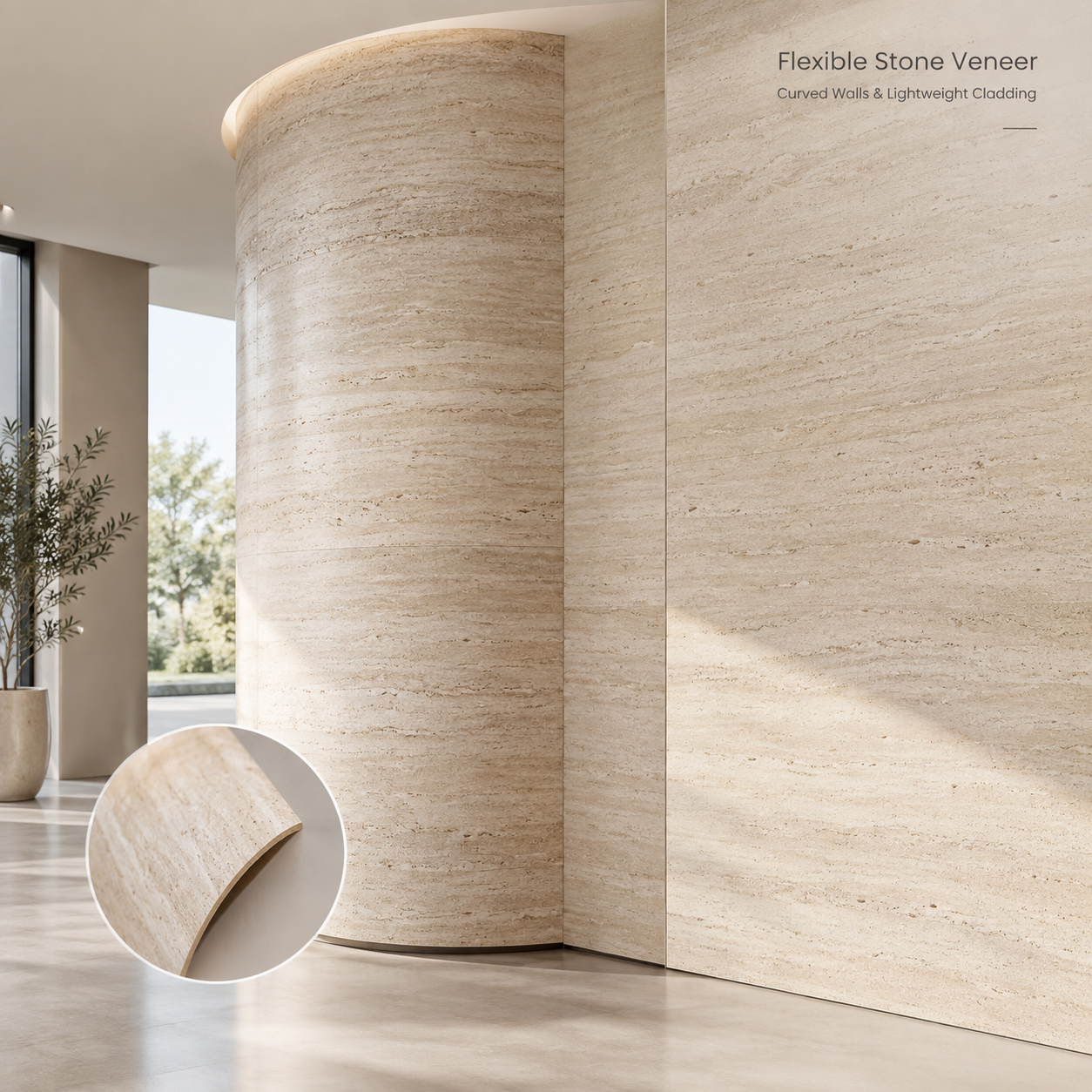
A wall finish can have the right color and still be wrong for the project. Weight, thickness, curvature, joint rhythm and substrate condition often decide whether the installation remains practical. This is especially true when designers want a continuous stone character across old walls, columns or radiused features.
RINSUN MCM Flexible Stone Veneer reproduces travertine, cut-stone, slate and rough-granite surfaces in thin, flexible panels for interior and exterior applications. Manufactured by WUXI RINSUN ECO MATERIALS CO., LTD, the collection helps architects, distributors and contractors coordinate appearance, geometry and installation rather than treating the veneer as a last-minute decoration.
Table of Contents
1. What MCM Flexible Stone Veneer Is Designed to Solve
2. Choosing the Right Surface Series for the Project
3. Flexible Stone Formats and Design Priorities
4. Why Thin Profile and Flexibility Matter
5. Substrate Preparation Controls the Finished Wall
6. Planning Joints Corners and Transitions
7. Quality Checks Before the Material Reaches Site
8. A Curved Hotel Lobby Installation Example
9. Frequently Asked Questions
10. Request Samples for Your Next Wall Finish
What MCM Flexible Stone Veneer Is Designed to Solve
Natural stone gives walls depth, mineral variation and a sense of permanence, but its weight and rigidity can complicate renovation, curved substrates and fast interior fit-outs. MCM Flexible Stone Veneer approaches the same design problem differently. It provides a thin, flexible facing with stone-inspired texture, allowing project teams to work across flat walls, columns and gentle curves without treating every surface as a conventional stone-masonry installation.
RINSUN organizes its collection into Travertine, Art, Line and Natural series. Current product options include travertine, cut-stone, slate and rough-granite effects. These are not interchangeable labels. Travertine emphasizes soft veining, cut stone creates a controlled architectural rhythm, slate uses directional mineral texture, and rough granite brings a stronger granular surface. The right choice begins with scale, lighting, viewing distance and the geometry of the substrate.
A veneer still depends on the complete installed system. Panel format, thickness, adhesive, substrate preparation, joint design and edge detailing work together. Buyers should evaluate the material and the installation method as one specification rather than selecting a surface from photographs alone.
Choosing the Right Surface Series for the Project
Travertine-look panels suit hotel corridors, lobbies, retail feature walls, exterior or interior cladding, ceilings, columns and selected furniture surfaces. Their softer linear movement can cover large areas without becoming visually noisy. RINSUN travertine panels are offered in 600 x 1200 mm and 1200 x 2400 mm formats with a published thickness of 2.5-3 mm.
Slate-effect veneer has a more directional grain. It is used for commercial facades, landscape walls, renovation work and interior feature walls. The current RINSUN slate panel is listed at 600 x 1200 mm and 3-4 mm thick. Its grain direction should be planned during dry layout because random rotation can make adjacent panels look disconnected.
Cut-stone effects work well for contemporary facade bands, columns, commercial interiors and selected furniture surfaces. Rough-granite effects suit residential or commercial exteriors, landscape walls and textured interiors. A buyer should compare several panels together, not only one sample, because the visual result comes from repetition, joint placement and variation across the installed field.
Flexible Stone Formats and Design Priorities
Surface series | Published format | Thickness | Recommended design focus |
Travertine | 600 x 1200 mm; 1200 x 2400 mm | 2.5-3 mm | Large walls, columns, ceilings and soft limestone character |
Slate | 600 x 1200 mm | 3-4 mm | Directional mineral grain for facades and feature walls |
Cut stone | Confirm by quotation | Confirm by series | Linear bands, columns, commercial interiors and furniture |
Rough granite | Confirm by quotation | Confirm by series | Textured exteriors, landscape walls and strong interior accents |
Why Thin Profile and Flexibility Matter
The 2.5-4 mm profiles published across current RINSUN products reduce the build-up compared with many rigid cladding approaches. That can be useful around door returns, transitions, ceilings, counters and renovation interfaces where every millimeter matters. Lower installed weight can also simplify handling and reduce the demand placed on some existing surfaces, although the project designer must still confirm that the substrate is sound and suitable.
Flexibility is most valuable on columns, radiused walls and continuous display forms. It reduces the need to cut a rigid material into many narrow pieces just to approximate a curve. Fewer interruptions can create a cleaner visual line. Still, flexible does not mean unlimited bending. The acceptable curve depends on product, orientation, temperature, adhesive and substrate, so the project radius should be confirmed with a sample and technical guidance.
Large-format panels can speed coverage and reduce joints, but they require careful handling, alignment and adhesive contact. Smaller panels may be easier around obstacles or in tight work zones. The installation team should choose format based on access and geometry, not only on the desire for fewer seams.
Substrate Preparation Controls the Finished Wall
A premium surface cannot hide a weak substrate forever. Before installation, the wall should be clean, dry, stable and sufficiently flat for the selected panel. Dust, oil, loose coating, movement cracks and trapped moisture can interfere with adhesion. Renovation projects deserve extra attention because an old finish may look solid while separating under load.
Dry layout comes next. Installers should check panel sequence, texture direction, joint positions, corners and cut locations before adhesive is applied. Travertine veining, slate grain and line textures all need deliberate orientation. A few minutes spent arranging panels on the floor or marking the wall can prevent an obvious pattern break in the completed area.
Adhesive must be suitable for both the veneer and substrate. It should be applied evenly, and panels should be pressed from the center outward to eliminate air pockets and establish full contact. Edges and joints need the detailing defined for the project, especially outdoors or near wet-service areas. Generic installation habits should not replace product-specific guidance.
Planning Joints Corners and Transitions
Joints are part of the architecture. A narrow, carefully aligned joint can make large areas feel continuous, while a wider expressed joint can reinforce a cut-stone language. The choice should be made before panel quantities and layout are finalized. Corner treatment also affects material use: wrapped returns, trimmed edges and separate corner details produce different appearances.
Transitions to metal, glass, timber, ceilings or floor finishes need enough room for tolerances and building movement. The veneer should not be forced into an irregular gap at the end of installation. Drawings should show where the finish stops, how the edge is protected and which trade completes the adjacent surface.
Exterior applications add exposure, drainage and sealant questions. The architect or contractor must confirm the complete wall assembly, local code requirements and compatible accessories. RINSUN provides technical data sheets and installation guidance by series, with project-specific detailing available on request.
Quality Checks Before the Material Reaches Site
Approval begins with representative samples. The project team should review color, texture, flexibility, thickness and surface direction under lighting close to the intended space. For a facade, an outdoor mock-up is more useful than a desk sample. For a retail interior, evaluate the material beside the planned lighting and surrounding finishes.
Order control should identify series, color, texture, panel size, thickness, quantity, batch expectations and packing. Visual variation needs an agreed boundary. A stone-inspired product should not look mechanically flat, yet adjacent panels must still form a coherent field. Batch allocation and installation mixing rules help balance natural-looking variation.
Packing protects thin panels from edge damage, contamination and uncontrolled bending. Labels should connect cartons to the order and series. Before dispatch, quantities, surface identity, packaging and requested documents are checked against the approved scope. Technical data sheets and material safety data sheets are available per series on request.
A Curved Hotel Lobby Installation Example
A hotel designer wants a travertine character across a lobby wall that flows into several cylindrical columns. Conventional rigid slabs would require substantial support, curved fabrication or many narrow pieces. The team selects thin travertine-look flexible veneer and builds a full-height mock-up around the tightest representative curve.
The mock-up reveals that the panel can follow the geometry, but the original seam plan places a joint directly in the strongest light. The layout is shifted so the seam falls in a quieter zone, and the veining direction continues around the column. The adhesive method and pressing sequence are confirmed on the actual substrate build-up.
The finished solution uses the same surface language on flat and curved areas while allowing detailing to change at edges and transitions. The case reflects a broader project lesson: flexible stone earns its value when geometry, layout and installation are resolved together, not when it is treated as a decorative sheet applied at the end.
Frequently Asked Questions
Can MCM flexible stone veneer be used outdoors?
Selected RINSUN products are specified for interior and exterior walls. The substrate, adhesive, joints, edge sealing, climate exposure and local project requirements must be reviewed as a complete system.
Can it wrap a round column?
The material is designed to conform to curved and cylindrical substrates, but the achievable radius depends on the selected panel and installation conditions. Test the tightest curve with a sample before ordering.
What panel sizes are available?
The current travertine series lists 600 x 1200 mm and 1200 x 2400 mm formats. The slate panel lists 600 x 1200 mm. Confirm the current format for the chosen series.
What should I send for a quotation?
Send elevation drawings, dimensions, surface series, desired color, substrate, interior or exterior location, curve details, quantity, delivery destination and project schedule.
Request Samples for Your Next Wall Finish
A dependable MCM Flexible Stone Veneer should match the design intent, follow the project geometry and arrive with a workable installation route. WUXI RINSUN ECO MATERIALS CO., LTD manufactures travertine, cut-stone, slate and rough-granite surface series for facades, columns, renovation and interior feature applications. Send RINSUN your drawings and finish direction to request samples, technical documents and a project-specific quotation.